We are pleased to republish “Spanish Tile Journey,” a travel column originally written by our company president, Naoyuki Yamauchi, for The Times Housing Newspaper, a local publication covering housing and lifestyle in Okinawa and part of the Okinawa Times Group.
A Majestic Library
Click, click. The sound of footsteps echoes along the steep cobblestone street as students in black capes come into view. A cold wind sweeps through the narrow alleyways and stone arches, catching the black capes of the female students.
This is not Hogwarts.
About three hours by train from Lisbon lies the historic city of Coimbra, home to the University of Coimbra, founded in 1290 and the oldest university in Portugal.
It is one of Europe’s most prestigious public universities, but what impressed me most was its remarkable library.
The interior is richly decorated in the Baroque style, with elaborate gold ornamentation throughout. Two-story bookshelves, surrounded by wooden columns and railings, hold volumes that are hundreds of years old.
The library’s historic collection numbers around 300,000 books. It is also famous for its unusual nighttime residents: bats are allowed to fly inside the library, where they help control insects that could damage the books.
Standing there, surrounded by centuries-old books and ornate architecture, it truly feels like stepping into the world of Harry Potter.
◇ ◇
Coimbra also has its own tradition of fado, but it is quite different from the style heard in Lisbon, where female solo singers are common.
In Coimbra, the singers are traditionally all men.
Coimbra fado is said to have begun with male university students singing to express their feelings to the women they loved. The singers and guitarists dress in black capes and perform songs filled with passion and longing.
Near City Hall, a theater called Fado ao Centro offers performances of traditional Coimbra fado.
There is also a unique custom at the end of a performance. Instead of applauding, audience members traditionally clear their throats with a soft “ahem, ahem.”
Foreign visitors, however, often respond with enthusiastic applause.
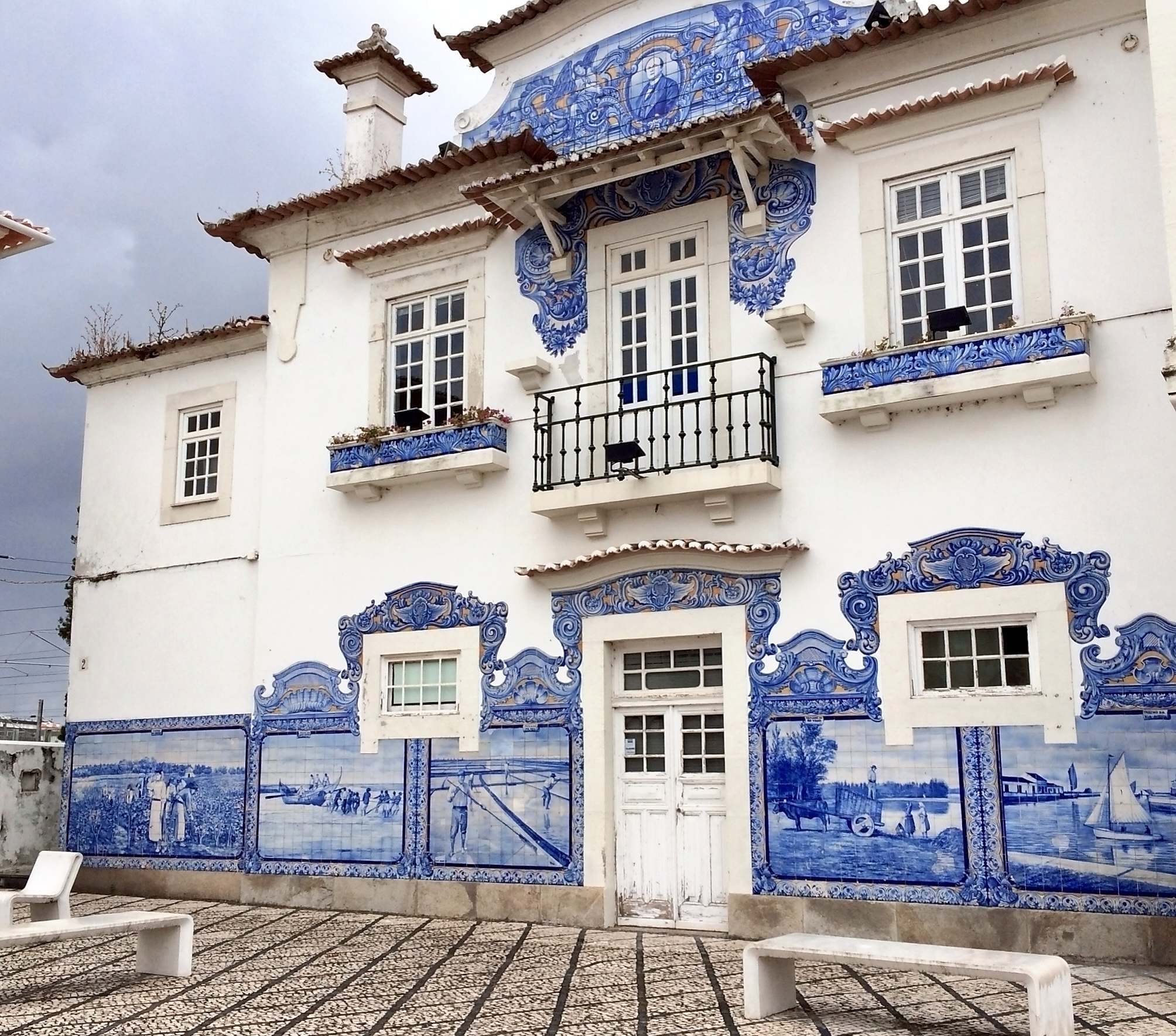
Tile Art Throughout the City
In addition to Spanish tile, our company also carries products from Pavigrés, a Portuguese tile manufacturer whose headquarters and factory are located about 30 kilometers north of Coimbra.
Like Spain, Portugal has a long history of tile production. Pavigrés products are widely used in public facilities, and the company exports advanced, high-quality porcelain tile to markets around the world.
While traveling by train from Coimbra to Porto, I decided to get off at Aveiro.
There, by chance, I came across the city’s old train station, covered with magnificent tile panels that looked almost like scenes from an epic story.
One of the great charms of Portugal is that you do not have to visit a museum to encounter beautiful tile art like this. It can be found throughout everyday streets and public spaces.
Aveiro has long been known for salt production in its coastal lagoons. Canals were built through the city to transport salt, earning Aveiro the nickname “the Venice of Portugal.”
Making an unplanned stop along the way is one of the true pleasures of traveling.
◇ ◇
Porto is Portugal’s second-largest city and is famous around the world for port wine. The view along both banks of the Douro River, with rows of white-walled houses and orange rooftops, is probably one you have seen on television or in travel photos.
Porto is also home to Livraria Lello, often described as one of the most beautiful bookstores in the world.
Inside, an elegant wooden staircase known as the “Stairway to Heaven” rises through the center of the store. Bathed in light filtering through the stained-glass ceiling above, it is a sight that is hard to look away from.
It is often said that J.K. Rowling, author of the Harry Potter series, visited the bookstore frequently while living in Porto and teaching English, and that the atmosphere may have helped inspire elements of the world she later created.
One day, while I was waiting for a streetcar near Carmo Church, local people kept coming up and talking to me, completely unconcerned by the fact that I did not speak Portuguese.
An elderly man with a cane asked me where I was going.
“The railway museum,” I replied.
“This is your streetcar,” he said, boarding first and motioning for me to follow.
When we reached my stop, he got off with me, saw me safely on my way, and then boarded the next streetcar to go back.
He had come along even though he had no reason to go there himself.
The people of Portugal struck me as warm, down-to-earth, and genuinely kind.
Viva Portugal!


About the Author
Naoyuki Yamauchi was born in Okinawa City, Okinawa. After studying in the United States, he worked for an American trading company before founding Pantech Corporation, a Spanish tile distributor, in 1995.
He enjoys fishing, music, and collecting jazz records from the 1950s and 1960s.